Step 3 of five
Iron Columns Inside a New Lobby
The building went. Eleven columns did not. What is left is a real piece of one building standing inside another, which is the whole of step three and the step people find hardest to read.
The five questions
| What it was built to do | Carry the floors of a four story commercial block on a cast iron frame, one column every twelve feet, with the outer wall doing no structural work at all. |
|---|---|
| What happens there now | Stand in a line down the middle of a new lobby, carrying nothing, lit deliberately, with the new structure passing either side of them. |
| What you can still read off it | The taper, the collar at the top and the bolt lugs at the base. Cast iron columns are hollow, slightly conical and cast in one piece, and nothing made since looks like it. |
| Where you can stand to see it | The lobby is open in working hours, and the columns can be seen from the sidewalk through the glass at any hour. |
| What has gone for good | Everything else. The wall, the floors, the stair, the roof, and the iron that was not in the middle bay. |
Why columns and not walls
Because a column can be lifted out, put on a truck and put back.
A wall cannot. It is continuous, it is heavy, it is bonded into everything it meets, and taking it down without destroying it costs more than the wall is worth. So when a building is going and somebody wants to keep something, what gets kept is what can be unbolted: columns, a stair, a door surround, a run of railing.
This step is a study in what is portable. That is not sentiment, it is haulage.
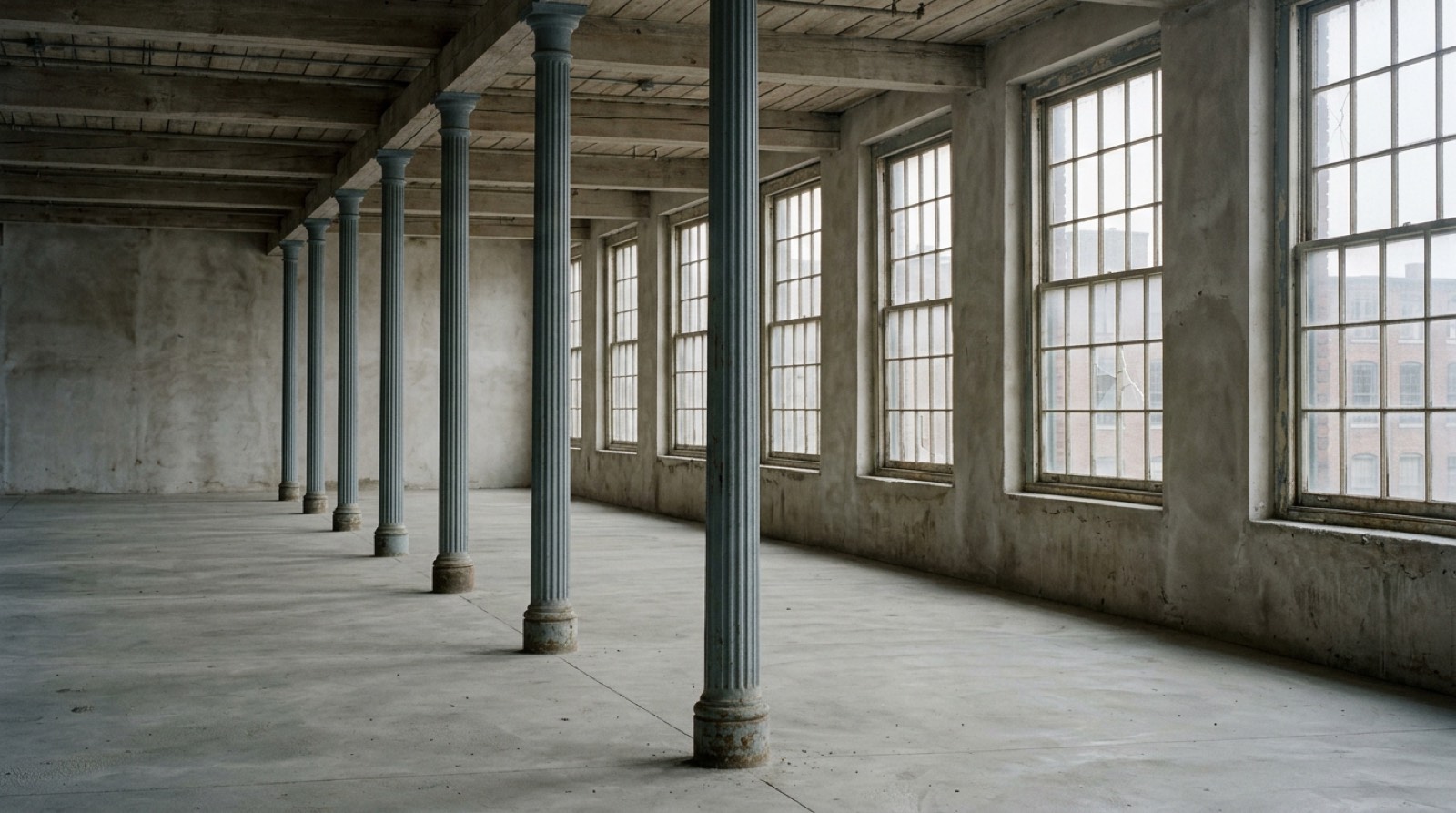
Telling real from cast copy
Three checks, and any two are enough:
- Taper. Real columns are slightly narrower at the top. It was cheaper in iron and it is structurally correct. A decorative reproduction is usually parallel.
- The seam. Cast in a two part mould, so there is a faint line running the full height on two opposite sides. Painted over, but you can feel it.
- Lugs. At the base and the capital there are cast lugs with bolt holes, often broken, often filled. A copy has no reason to have them and usually does not.
A fourth, if you can get close: knock it. Cast iron rings and stops. Steel rings on. Painted timber does neither.
Retained and honest, or retained and dishonest
There is a difference and it is worth naming.
A column kept where it stood, carrying nothing, in a room whose geometry acknowledges it, is a piece of evidence. A column moved across a site and arranged as a feature is decoration made of evidence, and it tells you nothing about where anything was.
Neither is wrong. But only the first is useful to somebody trying to read the site, and the plaque never distinguishes them.
Practical
- The lobby is private ground open in working hours. Walk in, look, do not photograph anybody.
- Through the glass works fine at any hour and is the easier photograph.
- No facilities for a visitor. It is a lobby.
- If a desk asks what you want, the true answer, that you came to look at the columns, has never once caused a problem.